
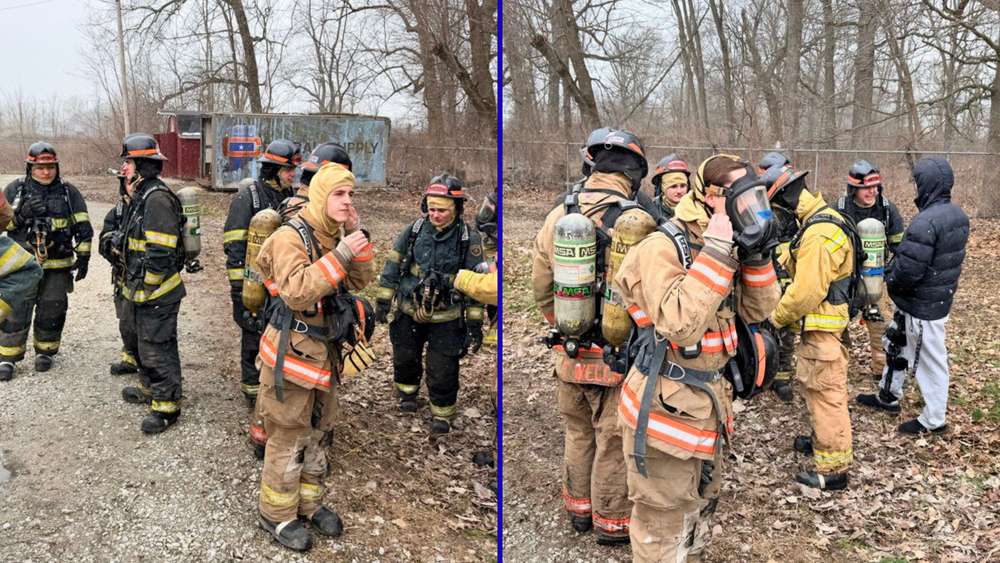
At the New Castle Career Center (NCCC), learning doesn’t stay confined to textbooks and classrooms. For students in the Fire & Rescue program, the curriculum literally turns up the heat.
Recently, under the guidance of Fire/Rescue Instructor Tim Welch, students stepped into one of the most intense and transformative experiences of their training: live fire evolution at the training ground.
This is where theory meets flame.
From Classroom Concepts to Real Fire Training
“Live fire training is a core experience for new firefighters,” Welch explained. “Without it, new firefighters would miss the opportunity to experience the real feel of fire.”
Fire can be unpredictable and intense, but this training helps students experience those challenging realities safely, within a controlled environment that simulates what they will face in the field. And before participating in the live-fire training, students had to complete over 150 hours of hands-on preparation. This included finishing the Fire I curriculum and passing their state certification exams. By the time they reach live fire training, they are prepared trainees.
Within the training structure, students encounter a full spectrum of fire behavior, including flashover, rollover, high heat, and thick, turbulent smoke. Students witnessed the stages of fire development in real time.
“We train to use all of our senses,” Welch said. “When vision is no longer possible, we learn to listen and feel for changes. We watch for the color change of the smoke and its density as well. These are all clues of a possible flashover, which can be dangerous if not recognized quickly.”
Safety At The Core of Fire Training
While the experience is live, a safety system operates behind the scenes. Training strictly follows standards set by the National Fire Protection Association, specifically NFPA 1403. “Safety is our number 1 priority at all times,” noted Welch.
Additionally, firefighters from the New Castle Fire Department are present throughout the exercise, ready to assist at any moment.
The first reaction to live fire sparks is a mix of emotions. “The excitement is real,” Welch said. “There is fear and nervousness, which is normal and expected, but the students have learned to trust their training and the protection of the gear they wear.”
While nothing can fully replicate an actual emergency, this training comes close. “This is as close as we can get without an actual residential fire,” Welch explained.
Students conduct safety walkthroughs of the facility beforehand to familiarize themselves with it. Then, once the fire is lit, they experience conditions that mirror what firefighters face in homes and businesses. The live fire training helps them answer an important question: Am I ready for this? It’s a critical step toward becoming firefighters who can protect and serve their community.
For Welch, the most powerful part of the experience is watching students come to this realization.
“The most profound moment is watching the faces of the students as they observe and understand what has been taught and is now happening in real time.”
To explore the program, course offerings, and enrollment details, visit https://www.nccareercenter.org.